
A THREE POINT STAR WITH NO SHINE
Nothing beats 4 errors in a row when it comes to vehicles
10/29/20255 min read
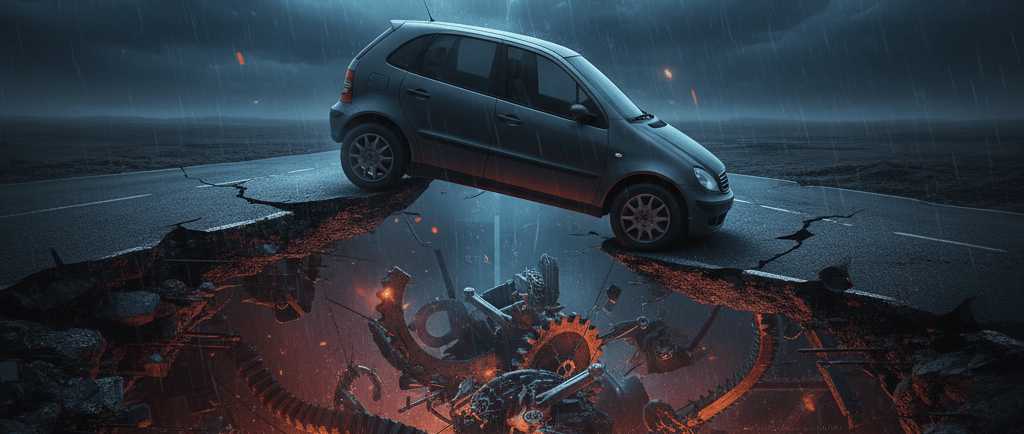

Last week I wrote about the attempts at change at the VW Group and remembered another case involving automobiles. Being a car enthusiast, I have quite a few cases saved.
The one I'm about to share highlights not only a common mistake—price positioning in an unfamiliar market—but also a certain arrogance on the part of the brand in that market. It was 1999, and Mercedes was launching the A-Class, its first compact, front-wheel-drive vehicle manufactured in Brazil.
Expectations were high, especially among car enthusiasts and the brand. Finally, a Mercedes with the price of a Brazilian car. The car had a controversial history: besides being the first Mercedes with front-wheel drive, it had undergone a massive recall due to an accident involving the famous moose maneuver, performed by a German magazine. This maneuver, which simulates a sudden swerve due to an animal on the road, requires the car to have optimal weight distribution and a low center of gravity, since suddenly, at 70 or 80 km/h, the driver swerves sharply to avoid the "moose" and then immediately returns to the original trajectory.
Before criticizing the car, let's remember that the design was very bold and ahead of its time: a car the size of the Honda Fit (which didn't exist yet and owes its design to Mercedes), with a small (1.6-liter) engine, and an entire design thought out for the car's shape, to ensure the greatest possible interior space. One of the features touted during the sales pitch was the double floor, which, according to the advertising, protected occupants in a side impact, since cars were much lower at the time. I recently read that this double floor and the design flaw that led to the recall was actually a bold idea that wasn't viable: the floor was supposed to contain the first battery plate in passenger cars, anticipating the wave of hybrid vehicles. I don't know, but it makes sense.
The fact is that this floor significantly raised the car's center of gravity, which caused it to fail the moose test and a recall of over 10,000 vehicles produced, sold, or at the brand's dealerships, for the installation of the first electronic traction, stability, and body roll control systems in an entry-level vehicle. Only top-of-the-line versions of the most luxurious models had this at the time (and many cars still don't have it today).
Despite the test fiasco, the automaker's decision to not only correct the problem but also include a series of features in every vehicle ever sold (those familiar with cases like the Ford Pinto in the US know this is rare) ultimately put the problems behind them.
At this moment, when Mercedes could have made history, it was the moment when arrogance (or shortsightedness) spoke loudest. Believing that the Mercedes-Benz brand was not only a consumer dream but also an established brand in Brazil, the launch strategy committed four of the biggest marketing mistakes a company can make:
Launching with the base model—a 1.6-liter engine, wheels with hubcaps, manual power windows in the rear, and a spartan finish.
Incorrect product and brand positioning—associating it with traditional trucks sold in Brazil: Brazilians who buy Mercedes cars are not the same as those who drive trucks or buses, and these worlds coexist.
Forgetting the law of scarcity—by launching the base model and associating it with trucks and buses (the advertisement literally referred to "your first Mercedes"), the brand undermined its exclusivity, attempting to reach a younger audience, which, here, is not the same as in Europe.
Incorrect price positioning—the initial strategy was to launch the entry-level model at R$23,000, which would be in the range of other 1.6-liter vehicles. However, in a study supposedly coordinated by pricing strategy experts, the conclusion was: if, instead of launching at R$23,000, the car were launched at R$27,000 (the same entry-level model), the increased margin would offset the lower volume of units sold (here, contradicting the decision to ignore the law of scarcity). The problem is that, in this range, the A-Class would compete with none other than the Vectra, the best-selling and desirable object of the time (with a 2.0-liter engine, plenty of space, and well-equipped), and even the Scenic, a larger van, more suited to families, which in this price range was better equipped.
I know about this pricing issue because a friend of mine was best friends with one of the experts who reached this price conclusion. The day he told me this story, he commented on the team's cleverness, and I made an observation that stuck with me: "So, tell your friend that he may understand math, but not marketing. At this price point, they won't sell anywhere near what they expect," I said, convinced. This statement came shortly after a meeting where the automaker's Sales Director told the president of an insurance company that the estimate would be at least 85,000 vehicles sold per year. I whispered to my colleague at the company that it was wrong and if they could end selling 20,000 vehicles would be a lot.
Well, everyone knows the result: less than 10,000 vehicles sold, a desperate attempt to recover the car's image with the launch of the 1.9 engine, luxury Elegance and Avantgarde versions, a clutchless manual transmission (which was a flop), and a lot of advertising. The fiasco was so great that it generated a stalemate between the manufacturer and the governor of Minas Gerais, who felt betrayed when the 30-year project was reduced to 6 (the manufacturer stopped production in 2005).
This shows that I'm a good marketing guru, right? No. Although I was very accurate in my prediction, the truth is that the case of the A-Class in Brazil is a death foretold. By committing the 4 mistakes I mentioned, the manufacturer threw its product into a vortex that is almost impossible to escape. For far less than that, Chevrolet condemned the Corsa to be an entry-level car, with a relatively short lifespan. And it only made the first two mistakes: launching the entry-level model and ignoring the scarcity. The rest it did very well, but the vehicle never managed to stand out from other entry-level models.
A crucial mistake made by Mercedes in its positioning was separating the brand from the product. However good the brand image may be, the product is the tangible embodiment of what it promises. By delivering a vehicle that had the three-pointed star emblem but wasn't a legitimate representative, it condemned the A-Class manufactured here to an aberration, an odd one out. A Mercedes that wasn't worthy of displaying the brand.
Part of this stigma wasn't the strategy's fault, I acknowledge. The 3.85m long A-Class was a precursor to compact urban vehicles that were small on the outside and large on the inside, economical, and designed from the inside out. And it allowed Mercedes to adopt front-wheel drive (as did BMW), demonstrating the automaker's ability to use technology to guarantee drivability and performance, among other achievements. But no product survives serious positioning and launch errors. Especially vehicles, which are desirable and durable goods. Making a mistake in defining the space it should occupy in consumers' minds tends to be fatal. The question is how long this error will survive in the market. But when that happens, it's difficult for the model to survive and become a classic, for example.
But that's another story.