
DON'T ASK ME WHY AI
What is AI really for?
4/15/20263 min read

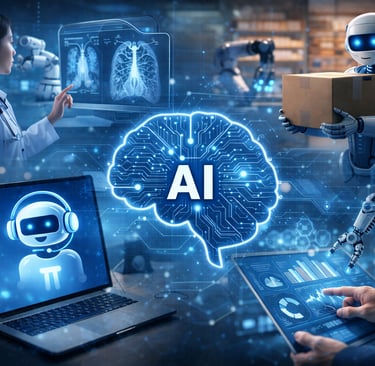
Returning to my current favorite topic, AI, with so much controversy surrounding it, the question you need to ask is very simple: why do I need AI?
Before answering, let's address some controversies:
The AI bubble will burst - we've already discussed this here, and for most people, it doesn't change anything.
LLMs (long language models) have reached their limit - this is still a statement from some experts, but there's some truth to it. LLM is the first generative AI model for mass use and, just as happened when the internet bubble burst, it's the precursor to what's to come.
AI hallucinates and doesn't give true answers - this one is more philosophical: what is truth? Current AI relies heavily on the user and their history. Want a really unpalatable truth? It's better at understanding what humans think than at helping them think better, in other words, we are lab rats. That's why META invests so much in AI, that's why Microsoft is behind ChatGPT, and that's why Google is so committed. Mastering AI means mastering human behavior to predict what it will do. This is the reason that led Apple to go in the opposite direction: Apple doesn't try to anticipate what the customer wants, as Steve Jobs always said, but to propose what they haven't even thought of yet.
AI is delusional and very ineffective - that's a lie. From a philosophical standpoint, yes, it was made to respond to and read the user. But it has mechanisms behind it that correct and improve the response. But making mistakes has ceased to be human and has become artificial: with the mistake, you have a higher consumption of tokens than you need. And how do companies profit from this? When you are developing something, the AI will make mistakes and will consume tokens apparently doing something that will lead to nothing. It's exactly like you saying you left home for an appointment and haven't even showered yet. In this case, you save time. In the case of AI, it pretends to have done something while consuming its credits but not using real processing power (which is what costs companies). I myself have had 30 million credits (in Rocket.new tokens) returned because the agent said it had fixed something but hadn't.
AI hallucinates - yes, because it is learning. Hallucinating is part of the trial-and-error process which, setting aside any conspiracy theories, is a necessary stage for it to learn. AI agents are like gifted children: on the one hand, they have an extraordinary ability; on the other, they are naive and childish in basic things; and both will learn.
These are some theories. So, the question is not whether this is true or not, but what you intend to do with AI. Those who don't use AI today live disconnected from reality. Everyone uses it at least a little. I'll give examples:
Every Google search today starts with an answer from Gemini.
Your smartphone keyboard, which enlarges when you click, doesn't have a fixed behavior: it's based on a predictive model that uses one of the first AI models on the market. It enlarges the key that seems most likely based on what you've already typed and the position of your finger. That's why sometimes the error repeats itself several times even if you type again.
Siri was one of the first AI prototypes, 14 years ago, and anyone who has ever owned an iPhone has used it at some point.
Netflix (as well as Amazon) has long since evolved its algorithm-based recommendation model to AI.
But this is still only a fraction. I'll give some practical and useful examples of using AI in everyday life:
Don't remember an Excel function?
Want a quick analysis of data from various sources and periods?
Want to do in-depth research on a topic you once asked your encyclopedia editor about?
Have a question about a decision to make?
Do you need an analysis of a legal document?
Do you want a different image, one that doesn't already exist or that you need to use for commercial purposes?
Do you want automation of daily tasks, including personal alerts?
Are you having trouble writing a personal or professional text?
Do you need an analysis of a business model?
Do you want a control panel that integrates different data?
Do you play an instrument or enjoy writing song lyrics?
Again, this is just a small sample. The question of AI is no longer whether or when, but how you will use it. From sales strategies to content production, AI is an indistinguishable part of modern life. Look at the internet: nobody even talks about it anymore because being online is a given. In fact, that's how this text reached you.