
SEO, GEO AND SEMANTIC BRANDING
If you don't know what they are, you must discover them now
5/21/20264 min read
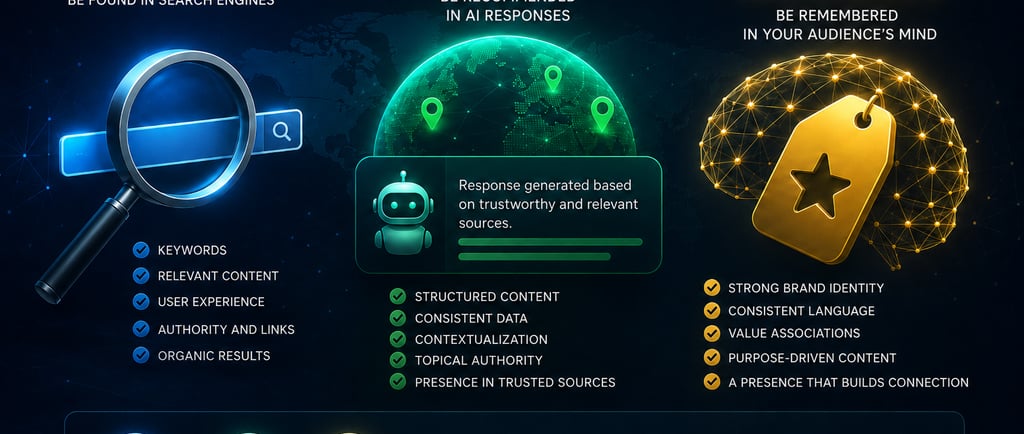
One of the recent terms used in the daily use of Artificial Intelligence is GEO, or Generative Engine Optimization, or Search Optimization for Generative AI. GEO emerges as a counterpoint to traditional SEO and promises to change everything. In fact, GEO has barely emerged and has already branched out into AEO, or Answer Engine Optimization.
All this change becomes easier to understand when you realize that Google has made its biggest bet in recent years, even bigger than the changes to Ads and Analytics made in 2024 and 2025, with the goal of being number 1 in Generative AI. To this end, it launched a package of changes that includes redefining its main source of revenue, sponsored links.
Yes, to understand the magnitude of the changes, the search now includes AI features and the results shift their focus from volume to precision. Those who have been following the changes made to Google Ads and Analytics already knew that formats were changing, that text-based sponsored links were progressively dying out, and that assertiveness was surpassing volume.
But the current change is much bigger, which leads to the terms in the title. Until this week, literally, GEO was a very important focus, but it wasn't the main focus yet. Now, everything has changed. Because GEO creates a new layer in searches that goes where SEO doesn't. It goes to AIs, checks what they are searching for, what they say about your brand (or worse, what they ignore), and what you need to do to reach them. Because it's a fact that more and more people will be searching with AI and not just with an empty text box. In the same way that Google's algorithm was crucial in 2004 to bring relevant results from a universe of millions of pages, AI is now fundamental to bringing results from the estimated 50 billion pages currently.
In the case of AEO (Applied Electronic Optimization), the focus is on smart devices, such as Alexa, Siri, etc., which already incorporate AI; we're talking about providing these devices with information about products and services so that they incorporate it into their responses. In other words, for each type of device, we have a type of optimization and a way to generate results, which increasingly involve prompts and APIs.
These changes, even though they threaten the survival of its core business, show that Google did what most leading companies don't: it had the courage to reinvent itself before the competition did it for it. If Google had the courage to do this, you and I can't be left out. Brand relevance, as I discussed in a recent text, depends on it.
That's where Semantic Branding comes in. Until the 1980s, branding and category were very closely related. A company invented a new product, advertised it, and that product became synonymous with the category. This was the case with Gillette, Band-Aid, Maizena, etc. Then, the brand had to look at all the Ps, which increased over time, until the concept of 360º Branding emerged. With the Internet, the 360º concept began to go round and round, until it fragmented and the Metaverse emerged.
No, the Metaverse didn't die. It just became something more tangible, less ethereal, and more practical. Semantic branding is a step in this process of associating the brand with contexts relevant to its promises and to the various targets (which continue to fragment), so that it receives contextualized and relevant recommendations for these targets.
Will SEO die with GEO? I believe not, but it becomes a superficial layer. First, via GEO, AIs will search for answers and, to organize them, will use SEO. But, once the search begins with AI, it's no use having great SEO if GEO isn't finding your results; in other words, your brand will be well-positioned, but invisible to AIs.
Of course, like everything in technology, this isn't definitive, but my experiences with GEO show that the importance of the investment has grown abruptly and produced concrete results: sales. At first, I was fascinated by the meteoric evolution of the overall results, but in a short time I saw the results in leads and sales. This indicates that it's not just an aid, but an essential strategy. When you look into the inner workings of this process, you see what was said above: GEO allows AIs to deliver recommendations for your brand contextualized with the doubts and questions of various user segments.
And it's not hard to understand why this happens: Google search has accustomed us to having answers to our questions. AI is increasingly solving problems. We don't ask for a list of products; we ask which is best for our needs.
If Google has changed, the message is clear: change while there's still time. The greater the dispersion of the consumer, the more they tend to use tools to help in their decision-making. Among Google's new features are agents that perform product searches.
They compare the characteristics of each offer, gather payment methods, and deliver all this information in a spreadsheet to the user. So, it's no longer enough to offer your products the way you used to, because increasingly, AI will be interacting with your website in search of specific answers.
And it's not just about creating prompts, because that's already become the AI's job. In the first wave in 2024/2025, the client's challenge was to communicate with the AI in the most natural language possible. For that, the prompts had to be enormous, full of meta-information. In the second wave, also in 2025, AIs began to incorporate some prompts and only needed indications or answers to questions. Then came the agents, which generated the prompts for you. Now, AI communicates with AI and corrects the errors itself. Errors aside, which still happen daily in abundance, the path is assertiveness. Nobody wants to spend time trying to understand what they said they ordered or what was poorly ordered. In Google's case, it's using its more than 20 years of learning about what people are searching for to try to better and faster answer their needs, not just their questions.
In short, the change is radical, the speed is brutal, and the reality is merciless. Until the AI bubble bursts, standing by and observing is not an option.